
FAQ (Frequently Asked Question)
LPG stands for Liquefied Petroleum Gas and is a petroleum product consisting of a mixture of flammable hydrocarbon gas, primarily propane and butane, produced either from a crude oil refining process or extracted from natural gas.
What’s in a Name?
LPG stands for “Liquefied Petroleum Gas”. The term is widely used to describe two prominent members of a family of light hydrocarbons called “Natural Gas Liquids” (NGLs): propane (C3H8) and butane (C4H10).
The term “liquefied gas” may seem a contradiction in terms since all things in nature are either a liquid or a solid or a gas. Yet, liquidity is the unique character of LPG that makes it such a popular and widely used fuel. At normal temperature and pressure, LPG is gaseous. It changes to a liquid when subjected to modest pressure or cooling. In liquid form the tank pressure is about twice the pressure in a normal truck tyre, which means it is very safe when properly handled. LPG is a derivative of two large energy industries: the processing of natural gas liquids and the refining of crude oil.

Properties of LPG
There are more than 1,000 applications of LPG. It is used in commercial business, in industry, transportation, farming, power generation, cooking, heating and for recreational purposes. LPG is used throughout the home, as a gas to cook with, a source of fuel for central heating and hot water. LPG is also commonly used in the agricultural sector and as a lower emission automotive transportation fuel.
Uses of LPG
Domestic
The common domestic uses of LPG include cooking, heating, refrigeration, gas lighting, clothes drying, and air conditioning.
Commercial
Commercial uses of LPG are similar but in bigger quantity as required by hotels, restaurants, and hospitals.
Industrial
The industrial uses of LPG are cutting, soldering, grain drying, tannery, and tobacco drying.
LPG has two origins: 60% is recovered during the extraction of natural gas and oil from the earth, and the remaining 40% is produced during the refining of crude oil. LPG is thus a naturally occurring co-product. In the past LPG was destroyed through venting or flaring (i.e. the burning off of unwanted gas), wasting the full potential of this exceptional energy source.
LPG can be transported virtually anywhere, either in cylinders or bulk tank. It can be transported using sea, rail or road transport. LPG does not use piped networks, reducing vulnerability to supply disruption. Trucks transport butane and propane cylinders from the bottling plant to retailers, as well as to private and professional customers. Meanwhile, small bulk trucks distribute LPG from the storage centres to various consumers.
Production and distribution
Production
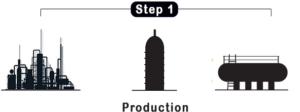 The production of “field grade LPG” is the result of the treatment of NGLs. This treatment is necessary to produce: a) Oils that are suitable for transport to refineries and b) Natural gases that correspond with commercial specifications.
Transportation
 While crude oil is transported from the production sites to refineries by tankers or pipelines, LPG is transported to storage terminals by large LPG carriers, pipelines or train.
Refining and Storage
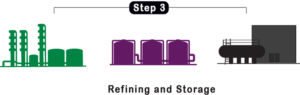 Butane and propane can also result from the oil refining processes. LPG storage terminals store products that are imported in large quantities..
Transportation
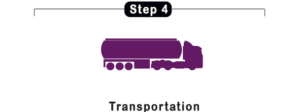 The LPG is then delivered by train, road, coastal tanker or pipeline to cylinder filling plants and intermediate-size storage areas.
Bottling and Storage
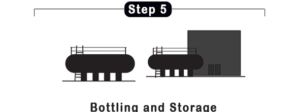 Cylinders are filled with butane and propane at bottling plants. LPG is generally stored in pressurised tanks (vessels or spheres) in intermediary storage centres.
Distribution
 LPG can be transported virtually anywhere, either in cylinders or bulk. Trucks transport butane and propane cylinders from the bottling plant to retailers, as well as to private and professional customers. Meanwhile, small bulk trucks distribute LPG from the storage centres to various consumers.
End Users
 LPG is easily available to end users through cylinder sales points such as commercial stores or service stations close to their locations. Customers requiring larger volumes can purchase LPG in bulk.
LPG is an exceptional energy source due to its origin, benefits, applications and its industry. As a clean, lower carbon, efficient and innovative energy it offers benefits to consumers, industry and the environment. LPG is a clean-burning, sustainable and efficient fuel and a vital source of energy for hundreds of millions of people throughout the world today. It is a multi-purpose energy with literally thousands of applications. It is portable, can be transported, stored and used virtually anywhere in the world and there are sufficient reserves to last for many decades. LPG also shows lower greenhouse gas emissions than petrol, diesel, and electricity, on an energy-equivalent basis.
LPG contributes to improvement of the wellbeing of whole communities. It has no hidden social impact. On the contrary, for developing rural communities LPG can provide a first modern alternative to traditional cooking fuels (e.g. firewood, charcoal, dung), contributing to a better quality of life and importantly, liberating women and children from time spent collecting fuel, thus enabling them to pursue education or value-added economic activities within the community.
Furthermore, exposure to a mixture of particles and toxic chemicals, generated when wood or other biomass material is used for indoor cooking, is responsible for widespread sickness and greatly reduced life expectancy for many people living in poorer communities. With its intrinsically clean burning characteristics, LPG offers a practical avenue towards cleaning up the air we breathe.
LPG also helps to reduce Black Carbon and Particular Matter emissions which not only compromises both outdoor and indoor air quality but can cause serious health problems. According to the World Health Organization, air pollution with Particular Matter claims an average 8.6 months from the life of every person in the EU.
There are many advantages of LPG. From a practical point of view, LPG provides a safe, steady and reliable source of heat. Cooks prefer its controllability over other forms of fuel – its visible blue flame and ‘instant on’ properties give you total control in the kitchen. Also, it’s one of the cleanest domestic fuel sources available.
Uses of LPG
Health
LPG is a clean burning fuel that provides smoke free indoor cooking and can also help reduce outdoor and urban air pollution.
Climate
Using LPG produces less CO2 than coal, heating oil or petrol, emits virtually no black carbon or other particulates and is as clean as natural gas.
Economic Growth & Social Progress
LPG is a driver for economic growth, especially in rural areas and developing countries.
Resources Efficiency
The majority of LPG produced is a co-product of natural gas and oil extraction and thus inherently resource efficient. LPG also plays a major role in reducing deforestation and desertification.
Efficiency
A billion people and businesses across the world count on LPG because it provides instant, reliable, constant and transportable energy.
Energy Future
LPG is a key component of a sustainable energy future in cities and rural areas both in developed and developing countries.
When sourced from a reliable supplier, LPG is one of the safest available domestic fuel sources. At Emirates Gas, everything we do is focused on ensuring the safety of the gas we deliver. Our processing and bottling plants are certified to the highest international standards. For more information, please visit our safety Guide.
LPG from Ghion Gas is ideally suited for the home. Our cylinders are certified safe, highly portable and available on demand. Our gas lights immediately, and burns with a bright blue flame, giving you total control.
Ghion gas LPG has a special added ingredient to help you detect leaks. In the rare event of leak and if you smell gas:
Step-by-step guide to dealing with a gas leakage.
In case of suspected gas leakage from LPG cylinder :-
- Switch off and remove the regulator from the valve.
- Put out all naked flames.
- Do not switch on or off any electrical appliances or use the telephone at the scene.
- Open all doors and windows to ventilate the house or building.
- If the situation is serious, evacuate at once.
- To check for leaks you can spray the cylinder with a soap solution (you can use washing-up liquid).
- Contact your Ghion Gas distributor immediately.
Bulk Supply (Gas Leak Indoors)
- Switch off the emergency valve on the outside wall of the building.
- Extinguish all naked flames immediately.
- Do not operate any electrical equipment and be aware of any equipment which may switch on or off automatically.
- Open all doors and windows to ventilate the building.
- Contact Ghion Gas immediately.
Bulk Supply (Gas Leak Outdoors)
- Turn off the gas at the main shut off valve under the tank hood.
- Extinguish all naked flames immediately.
- Contact Ghion Gas immediately.
Major Leak or Fire
- Call out the fire service and advise them that the leak or fire involves LPG.
- If the leak or fire is indoors, get everyone out of the premises.
- If the leak or fire is outdoors, evacuate people from the area and keep upwind of any leak.
- Contact Ghion Gas or your distributor immediately.
In case of emergency, contact 6317 or +251-114-162827.
LPG is one of the cleanest conventional fuels available. It is non-toxic and has no impact on soil, water and underground aquifers. It also helps to improve the quality of indoor and outdoor air, as it produces substantially less particulate matter and NOX than diesel, oil, wood or coal.
How can LPG contribute to fighting climate change?
From a global warming perspective, fuel selection can play a significant role in reducing emissions of carbon dioxide and other greenhouse gases. For many applications, including transport, cooking, heating, industrial processes and local power generation there is a major role in small and medium scale applications for alternative low carbon fuels, such as LPG, which have a smaller carbon footprint than traditional fuels.
Studies consistently demonstrate that LPG generates fewer carbon emissions than gasoline (petrol) and broadly equivalent emissions to diesel. In addition, the carbon footprint of LPG is 20% lower than that of fuel oil and 50% lower than coal. LPG therefore helps to reduce CO2 emissions.
LPG also helps to reduce Black Carbon (BC) emissions, which are the second biggest contributor of global warming and which can cause serious health problems.
As LPG can be used alongside renewable technologies, it serves as a clean energy source which is not dependent on weather or daylight, providing uninterrupted, clean and secure energy supply.
LPG is an energy-rich fuel source with a higher calorific value per unit than other commonly used fuels, including coal, natural gas, diesel, petrol, fuel oils, and biomass-derived alcohols. This means that an LPG flame burns hotter, an advantage that can translate into higher efficiency.
LPG was also found to have higher efficiency than natural gas fuelled distributed power generation which makes it ideal for rural homes and businesses. As a cost-effective energy source, LPG can be up to five times more efficient than traditional fuels, resulting in less energy wastage and better use of our planet’s resources.
LPG is extremely versatile and portable. It can be transported using sea, rail or road transport. LPG is available in a wide variety of packaging and storage options and is available in even the remotest of areas.
As one of the cleanest conventional fuels available, LPG complements renewable energy sources and technologies which depend on the weather or daylight. LPG also enables decentralized generation through small self-containing generators and micro combined heat and power.
Our wide network of distributors is on hand to deliver the energy you need and are just a phone call away. Please refer to the distributor list and get in touch with them.